 Dolpho
How to Breathe While Swimming Freestyle
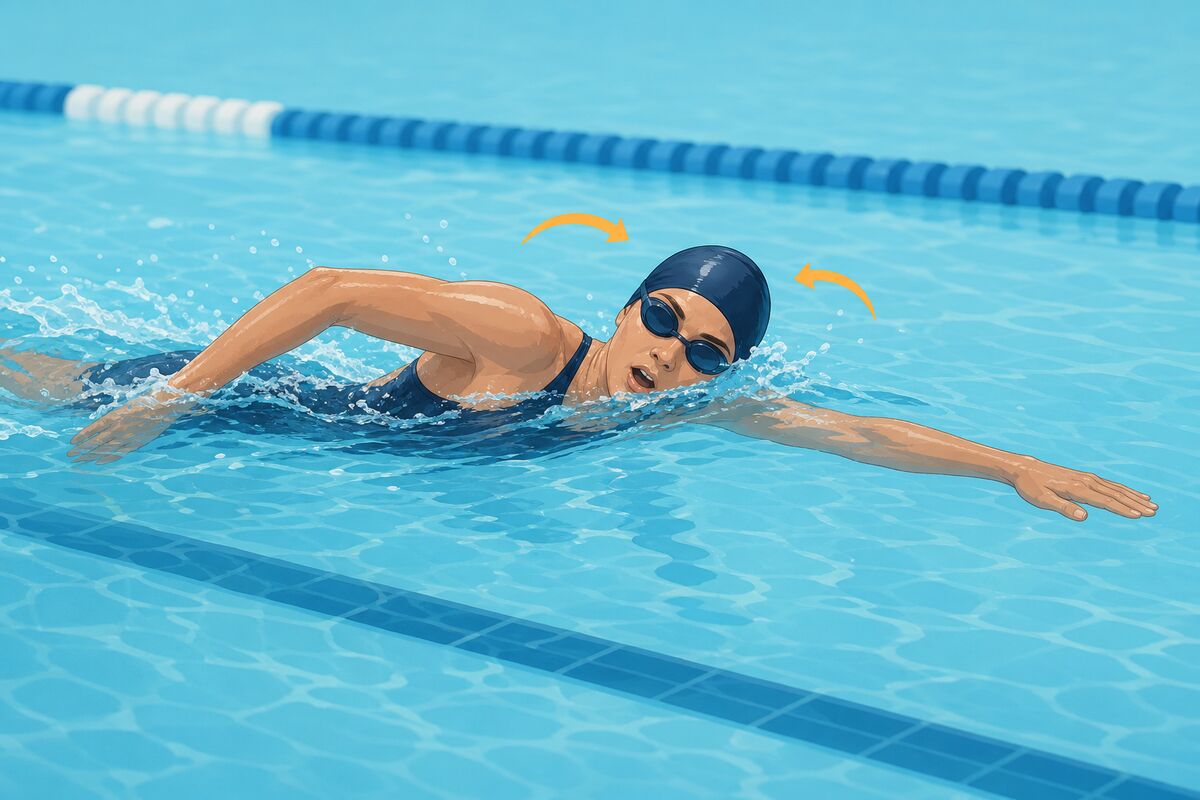
If you're out of breath after a single length of freestyle, your fitness is probably fine. Your breathing technique is the problem. Freestyle breathing goes against instinct: you breathe out into the water and get only a short moment to breathe in. Once that clicks, lengths that felt impossible start to feel calm.
Why you run out of air
Most new swimmers hold their breath with their face in the water, then try to breathe out and in during the one second their mouth is clear. That doesn't work. Air builds up in your lungs, CO₂ rises, and you feel desperate to stop, even though your lungs are full.
The fix is to breathe out underwater, all the time.
Step 1: exhale underwater
Stand in the shallow end, put your face in the water and breathe out slowly through your nose, mouth or both. Hum, or blow bubbles. Lift your head, breathe in, and repeat 10 times.
You should finish each exhale with a little air left, not completely empty. Here's the rhythm to aim for: a long steady exhale underwater, a quick sip of air above it.
Step 2: rotate, don't lift
To breathe, turn your head to the side as your body rolls with the arm stroke. Don't lift your head forward. Lifting makes your hips sink, which makes swimming harder, which makes you need more air.
- Keep one goggle in the water as you breathe.
- Turn your head with your shoulders. Your chin follows your shoulder back.
- Breathe in through your mouth in the small pocket of air your head makes as it moves through the water.
- Return your face to the water before your arm finishes its recovery.
Step 3: pick a breathing pattern
| Pattern | How it works | Good for |
|---|---|---|
| Every 2 strokes | Always breathe to the same side | Beginners and longer, steady swims |
| Every 3 strokes | Alternate sides (bilateral) | Balanced stroke, swimming straight |
| Every 4 strokes | Same side, longer gap | Faster swims once you're comfortable |
Start by breathing every 2 strokes to your more comfortable side. Try every 3 once breathing feels calm. It balances your stroke, but it's not required.
Four drills to practise breathing
- Bobbing. In the shallow end, sink down while you breathe out, then push up and breathe in. Do 10 in a row to train the exhale.
- Kick on your side. Kick with your lower arm stretched forward and your face in the water, then roll your face up to breathe. This is the side kick drill, and it teaches rotation without arm strokes to think about.
- Kickboard breathing. Hold a board at arm's length, kick, and practise turning your head to breathe every few kicks.
- Catch-up freestyle. Keep one arm in front until the other arm touches it. The slower rhythm gives you time to breathe properly.
Common mistakes
- Lifting your head forward to breathe. Rotate it to the side instead.
- Breathing out above the water. You lose time, and you'll gulp air.
- Over-kicking. A huge kick burns oxygen fast. Use a small, steady flutter.
- Swimming too fast. Learn breathing at an easy pace. It's much harder to relax when you're rushing.
Questions
Should I breathe through my nose or mouth when swimming?
Breathe in through your mouth, since it's faster and you get more air. Breathe out through your nose, mouth or both, whichever feels natural. Many swimmers hum out through the nose to keep water out.
Do I have to breathe on both sides?
No. Breathing to one side every 2 strokes is perfectly fine, especially while you're learning. Bilateral breathing helps balance your stroke, but it isn't required.
Why do I swallow water when I breathe?
Usually it's because your head turns too far or too late, or you're breathing in before your mouth clears the water. Keep one goggle in the water, turn earlier with your shoulder, and breathe out fully underwater so you only need a quick breath in.
How long until freestyle breathing feels natural?
Most people feel a big difference after 4 to 6 sessions of focused practice. Start each swim with a few minutes of breathing drills, and keep the main set at an easy pace.
Keep reading
Beginner Swim Workouts: 6 Pool Sessions to 1,000 m
Six beginner swim workouts that take you from short lengths with rests to a continuous 1,000 metres. Warm-up, main set and cool-down for each, with tips.
4 min read
6 Freestyle Swimming Drills for Beginners
Six freestyle drills that fix common beginner problems — sinking hips, short strokes and rushed breathing — with how-tos and a sample drill set.
3 min read